
Sincerities after Communisms
pluralising Ellen Rutten's fabulous book

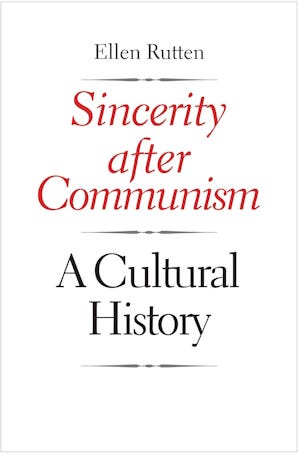
The work of Ellen Rutten is a massive find for this message-bottle. My ignorance of Sincerity After Communism (Yale University Press, 2017; hereafter SAC) is yet another cost of living in Beijing between 1999 and COVID; the pulse of global writing and scholarship was muted for a neat 2 decades…
Until recently based at the University of Amsterdam, Professor Rutten is a Russianist (alternatively, a Slavist). The ‘'Communism” of her title is indeed of the Soviet variety. Making mention here and there of China and its its chéng 诚 (traditional form 誠) sincerity discourse, like the proverbial cobbler she sticks to her Russian/Slavic last. This leaves room for swathes of Chinese or Sinitic family resemblance to be filled in.
I started in cultural history by way of anthropology in pre-poststructuralist times. Introducing SAC, Rutten identifies a global “new sincerity” trend, focusing on “the unique interplay of cultural memory, market forces, and new media in the aftermath of Communism”.
Living in Beijing, it easily passed me by. As did the “post-postmodern” frame of reference in which Rutten, not without irony, locates herself. Yet her angle of approach is more than compatible to this pre-postmodernist.
One of SAC’s online blurbs explains that it
…examines present-day sincerity rhetoric and its global outlines by focusing on Russia, a country that has historically maintained an excessive interest in the concept of sincerity. Over the past few years, the phrase novaia iskrennost’—the Russian equivalent of “new sincerity”—has been used by bloggers, politicians, and cultural critics to explain nostalgia for the Soviet era, Vladimir Putin’s media policy, and the Russian interventions in Ukraine…
Using the analytical perspective of a cultural historian, [SAC] argues that in today’s Russia, debates on sincerity and its inevitable contemporary twin, postmodernism, are always and inevitably debates on sincerity after Communism. It focuses on one social stratum within Russian society, cultural workers or creative professionals, with special attention to those working in the fields of Russian new media, cultural criticism, and literature.
This is enough to start some preconceptions racing, rabbit-like:
“Present-day sincerity rhetoric and its global outlines” is a thing (for aeons this was a challenge to imagine)…
precise equivalents to “new sincerity” may well have passed us by. It was unlikely to be directly translated into, say, “新诚信” xīn chéngxìn; xīn translates “new” in a straightforward sense
chéngxìn, while among the most common bound forms of chéng/sincerity today, typically figures in the narrow legal sene of “honesty” or “trust”
thus as a term in the notorious social credit regime. Claude has words of wisdom on this: link
“新真诚” xīn zhēnchéng looks glued together: possible but not promising.
“Sincerity in the PRC” is better framed as under than after Communism. To ascertain this, readers need go no further back than “Observing China: the Chan Method” by Yan Lianke 阎连科 (Beijing Baselines, 5 September 2024).
Russian “new sincerity” formed in the bowels of Stalinism; comparison with China must contend with Stalinism’s recombinant survival in the PRC.
Hence my reflection on Rutten’s work takes the heading ‘Sincerities after Communisms’: there’s surely more than one of each.
Whatever: Sincerity after Communism is highly recommended. Critical reviews that turn up on a casual search are gentle to the point of being praise with faint damns. Here are some:
Major Scholarly Reviews
Kevin M. F. Platt (Russian Review): “Sincerity after Communism is especially impressive for its transnational perspective and examination of globalised circuits of cultural interaction... In this age of postmodern politics, pervasive commercialisation, progressive digitisation of everything, and ever-increasing anxiety over a lack of sincerity, this book is a necessary reference for any consideration of contemporary Russian and global cultural life.”
Expert Endorsements
Mark Lipovetsky (University of Colorado-Boulder): “In her intellectually captivating and at times provocative book, Ellen Rutten analyses a discourse on sincerity as a self-sufficient narrative, with its inner logic, recognisable signifiers, rhetorics—in short, poetics... Sincerity after Communism contributes to the conceptualisation of Russian and global postmodernism by presenting the discourse on sincerity as the indispensable form of postmodernism’s self-critique, as its ferment of growth and the trigger for further renovations.”
Boris Groys (New York University): “In post-Communist Russia the requirement of the ‘new sincerity’ promised the liberation of art and literature from the ideological censorship but at the same time announced a new era of cultural marketing and rising importance of the blogosphere. In her groundbreaking book Rutten analyses this ambiguous role of ‘new sincerity’ using the recent examples from Russian literature and comparing them with analogous cultural phenomena in English and American literature and theoretical writing.”
Nancy Condee (University of Pittsburgh): “An enormous amount of thought, hard work, and research went into the tracking of the phenomenon of new sincerity. The topic is an extraordinarily complex one, the work is original and brave, and the scholarship is both sound and meticulous.”
Eliot Borenstein (New York University): “Sincerity After Communism is a major contribution to Russian studies, as well as to cultural studies more broadly.”
Academic Engagement
The book has been cited in various scholarly contexts examining:
Post-Soviet cultural transformations
New sincerity as a global aesthetic movement
Relations in contemporary culture between irony, cynicism, and sincerity
Digital media and authenticity
Postmodernism’s evolution